

Why Is Winnebago Stock Falling – Real Reasons
You’re seeing Winnebago’s stock fall mainly because lowered revenue and EPS guidance signal ongoing demand weakness and margin pressure amid a challenging economy marked by rising costs and cautious consumer spending.
Despite beating some earnings estimates, shrinking sales and cautious full-year forecasts weigh on investor confidence. Acquisitions haven’t offset these trends yet, while technical indicators suggest short-term strength.
Understanding these factors reveals why the stock struggles and what might lie ahead.
Key Reasons Behind Winnebago’s 2025 Stock Decline
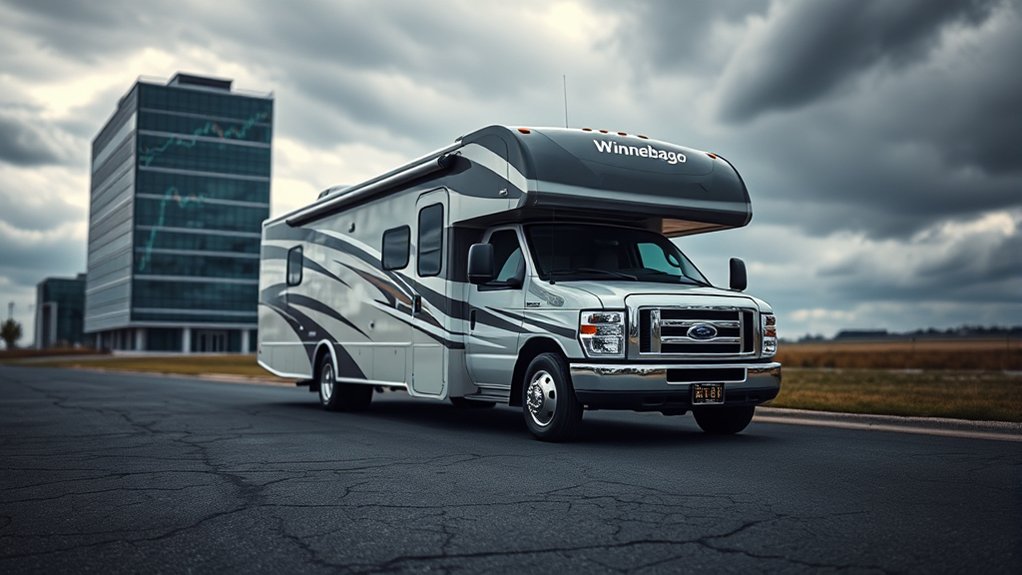
Although Winnebago surpassed earnings and revenue estimates recently, its stock fell sharply in 2025 due to cautious full-year guidance and lowered revenue and EPS forecasts.
Winnebago beat estimates but stock tumbled on cautious guidance and downgraded forecasts in 2025.
You need to understand the 11.8% year-over-year revenue drop in Q2 and a 54.2% decline in adjusted EBITDA, which point to shrinking margins and reduced profitability. These figures highlight operational challenges amid a tough demand environment.
Macroeconomic uncertainties further pressure analysts to revise expectations downward, reflecting increased caution.
Despite strong quarterly numbers, the stock price slid to $26.30, signaling investor skepticism about near-term growth.
The company’s revised outlook reveals limited visibility ahead, a key factor weighing on investor confidence.
This combination of financial weakness and uncertain guidance drives the stock’s 2025 decline.
It’s clear that even with some good news, investors are worried about what’s coming next for Winnebago.
The cautious tone in the outlook really hits their confidence hard.
How Q3 2026 Earnings Missed Expectations

You’re seeing Winnebago’s Q3 2026 earnings miss expectations mainly because revenue dropped about 10% year-over-year to $698.7 million.
That decline put pressure on earnings per share, which came in at 66 cents instead of the expected 80 cents.
So, with lower revenue and fewer sales, profitability took a hit.
It’s clear the company is facing some challenges moving forward.
Revenue Decline Impact
While Winnebago beat earnings per share estimates with 66 cents, the company’s Q3 2026 revenue declined by approximately 10% to $698.70 million, falling short of the expected $722.9 million.
This revenue shortfall stemmed primarily from weaker demand in the outdoor recreation sector, reflecting shifting macroeconomic conditions.
As you analyze these figures, it’s clear the revenue decline signals challenges in sustaining sales momentum.
This underperformance prompted the company to lower its full-year revenue guidance to between $2.65 billion and $2.75 billion, indicating ongoing headwinds.
Although earnings per share surpassed estimates, the missed revenue target raised concerns about Winnebago’s growth trajectory and market position.
Consequently, the revenue decline’s impact weighs heavily on investor sentiment, contributing markedly to the stock’s downward pressure.
Earnings Per Share Drop
Despite a revenue decline that signaled challenges for Winnebago, the company’s earnings per share also fell short of expectations in Q3 2026. You’ll see that EPS dropped 18% year-over-year to 66¢, missing analyst forecasts despite $698.7 million in revenue.
This 10% revenue decline, coupled with increased costs and lower sales volume, put significant pressure on profitability.
Even with steady gross margins at 13.6%, Winnebago couldn’t offset these headwinds. The company lowered its full-year guidance, signaling cautious outlooks that unsettled investors.
While some technical indicators suggested potential stability, the EPS shortfall clearly highlights operational challenges.
For you as an investor, these factors explain why Winnebago’s stock has been underperforming. It’s reflecting real concerns about earnings sustainability.
How the Economy Is Impacting Winnebago Sales

As the macroeconomic environment shifts away from pandemic-driven demand, Winnebago’s sales have noticeably declined.
Rising interest rates and inflation have increased the cost of financing and purchasing recreational vehicles, directly dampening consumer demand.
The shift to a more cautious consumer base means fewer large discretionary purchases like RVs.
Winnebago’s recent downward revisions to full-year revenue and earnings guidance mirror this sales decline.
The industry’s rapid growth during COVID-19 travel restrictions has slowed as travel habits normalize and economic conditions tighten.
You can see that broader economic pressures, rather than company-specific issues, are primarily driving this sales downturn.
It signals a challenging environment for Winnebago as it navigates reduced consumer spending amid higher borrowing costs and inflationary headwinds.
How Changing Consumer Demand Affects Winnebago
Because consumer demand has shifted markedly, Winnebago’s sales have dropped considerably, with quarterly revenue declining 11.8% year-over-year to $698.7 million.
Winnebago’s quarterly revenue fell 11.8% year-over-year to $698.7 million due to shifting consumer demand.
You should recognize that this decline reflects a shift from pandemic-driven travel surges to a more cautious spending environment.
Economic uncertainties have made consumers more selective, directly impacting RV purchases.
Management acknowledges this “challenged demand environment” and has reduced full-year revenue guidance accordingly.
The softer demand limits near-term visibility, signaling subdued market interest in outdoor recreation vehicles.
If you’re analyzing Winnebago’s performance, you’ll see that changing consumer preferences and increased prudence in discretionary spending are critical factors driving this revenue contraction.
This really underscores the need to monitor evolving consumer behavior closely.
What Recent Acquisitions Mean for Growth
Winnebago’s recent acquisitions of Newmar, Barletta Boats, and Grand Design have broadened its revenue base and product lineup, aiming to strengthen its position in recreational and specialty vehicle markets.
However, despite these strategic moves, the company reported an 11.8% year-over-year revenue decline this quarter, signaling integration challenges.
While the acquisitions diversify Winnebago’s offerings and target long-term growth, lower-than-expected earnings and a revised full-year outlook temper immediate optimism.
As an investor, you should note that these deals haven’t yet produced sustained financial gains amid ongoing industry uncertainties.
The mixed results suggest that although the acquisitions set a foundation for future expansion, realizing tangible growth benefits will require overcoming short-term operational hurdles and market volatility.
How Hedge Fund Moves Affect Winnebago Stock
Although hedge funds hold a relatively small position of 21 shares in Winnebago Industries as of Q4 2024, their active involvement signals institutional interest that can influence market sentiment.
You should note that despite recent earnings beats, hedge fund activity hasn’t stopped the stock’s 27.69% year-to-date decline.
Hedge funds often use their trades as signals, affecting how investors view Winnebago’s future performance.
This participation likely plays a role in the current valuation and investor perceptions surrounding the stock.
Additionally, hedge fund moves can increase volatility, which may contribute to the downward pressure you’re seeing on the stock price.
Understanding these dynamics helps explain why hedge fund actions matter, even with relatively modest shareholdings in Winnebago.
Technical Indicators Signaling Short-Term Moves
You’ll notice the MACD recently crossed above its signal line, and the histogram has turned positive. This hints at some short-term bullish momentum building up.
Keep an eye on key resistance levels around $36-$38 and $44 because these will be crucial in deciding where the stock heads next.
If Winnebago can’t break through these points, the momentum could fade pretty quickly.
MACD Momentum Shift
How can technical indicators reveal short-term shifts in Winnebago’s stock momentum? The MACD recently crossed above its signal line, signaling a bullish momentum shift despite weaker earnings. The MACD histogram turning positive suggests rising upward momentum, especially after reclaiming the 50-day moving average.
This technical signal contrasts with the cautious market sentiment. It indicates traders may be anticipating a short-term rebound.
| Indicator | Current Signal | Interpretation |
|---|---|---|
| MACD Line | Crossed above signal | Short-term bullish momentum |
| MACD Histogram | Positive | Increasing upward price pressure |
| 50-Day Moving Avg. | Price reclaimed | Potential short-term strength |
You should weigh these technical cues as signs of possible near-term price recovery.
Key Resistance Levels
When Winnebago’s stock approaches key resistance levels between $36 and $38, as well as near $44, you should monitor these zones closely for potential price reactions. These levels come from recent technical chart patterns and represent significant hurdles for upward momentum.
The stock has regained its 50-day moving average at $30.18, which signals a potential short-term bullish move. This is confirmed by the MACD crossing above its signal line.
However, the price remains well below previous highs near $50, and those highs serve as strong additional resistance.
Keep in mind, a drop below $28 would negate the current bullish setup and suggest further downside risk.
Watching price behavior around these resistance zones will help you figure out whether the stock can keep its momentum or face renewed selling pressure.
How Winnebago Compares to Other RV Stocks
Although the RV industry has seen a surge in demand, Winnebago’s stock has lagged behind competitors like Newmar, Grand Design, and Thor Industries. These companies have posted stable or growing revenues and maintained optimistic outlooks.
You can see the contrast clearly in three key areas:
First, revenue trends. Winnebago reported an 11.8% year-over-year revenue decline in Q2 FY2025.
Meanwhile, Thor and others saw stable or increasing sales despite market headwinds.
Next, stock momentum. Winnebago’s shares are consolidating near support levels.
On the other hand, its peers exhibit stronger upward momentum.
Finally, guidance and outlook. Winnebago’s cautious guidance stands in contrast to the more optimistic projections from competitors.
This difference is contributing to its underperformance.
Why Lowered Revenue and EPS Guidance Worries Investors
Because Winnebago lowered its fiscal 2025 revenue forecast to $2.8–$3.0 billion and reduced adjusted EPS guidance to $2.75–$3.75, investors are signaling concern over the company’s ability to sustain growth and profitability.
These revisions reflect a downward adjustment from prior estimates of $2.9–$3.2 billion in revenue and $3.10–$4.40 in EPS, indicating weaker sales and diminished earnings expectations.
Despite beating quarterly estimates, Winnebago reported a net loss of $0.02 per share in Q2 FY2025, which adds to worries about operational challenges.
The lowered guidance suggests persistent demand pressures and potential margin compression. This could hurt future financial performance.
As an investor, you should see these signals as cautionary signs of possible volatility and uncertainty in Winnebago’s growth trajectory.
It’s a reminder to stay alert and consider how these changes might affect your investment.
Should You Consider Buying Winnebago Stock Now?
Despite Winnebago’s recent stock decline, driven by lowered revenue and EPS guidance, you may notice signs of potential short-term recovery, such as the rebound above the 50-day moving average. When deciding whether to buy now, consider these points:
Winnebago posted strong Q2 earnings and revenue growth, but cautious full-year forecasts highlight ongoing demand uncertainties.
Winnebago’s solid Q2 results contrast with cautious full-year outlook amid demand uncertainties.
Analysts rate the stock as a “Hold” with a modest price target near $36.22, indicating limited immediate upside.
Macroeconomic headwinds and revised guidance continue to weigh on investor sentiment, suggesting long-term prospects remain uncertain.
Frequently Asked Questions
What Is Winnebago’s Long-Term Strategic Plan Beyond 2026?
You’ll see Winnebago expanding its product portfolio through acquisitions, optimizing supply chains, investing in digital marketing, and innovating outdoor recreation products.
They’re also maintaining financial flexibility to explore new market opportunities beyond 2026. It’s all about staying adaptable and ready for whatever comes next.
How Is Winnebago Addressing Supply Chain Challenges?
You’re strategically streamlining supply, strengthening supplier synergy, and signaling shifts swiftly. Winnebago’s data-driven decisions diversify sources, deploy digital dashboards, and detail delays.
This directly drives cost control and logistical logistics to lessen lingering supply chain lags. It’s all about staying ahead, adapting fast, and keeping things running smoothly.
What Role Does Innovation Play in Winnebago’s Product Lineup?
You’ll see innovation drives Winnebago’s product lineup by introducing electric models, enhancing durability, and integrating smart tech. These efforts aim to boost efficiency and customer appeal, positioning the company competitively despite market uncertainties and financial challenges.
It’s clear they’re really focused on staying ahead by blending new technology with reliable design. This approach helps them stand out and meet what customers want in a changing market.
How Is Winnebago Managing Its Debt and Financial Health?
Think of Winnebago as a steady ship steering through financial waters. They’re maintaining disciplined cost control and stable 13.6% gross margins. Plus, there’s no rising debt to worry about.
On top of that, they offer a solid 5.48% dividend yield. This all adds up to strong financial health and flexibility. It’s a pretty reliable setup for the company moving forward.
What Impact Do Environmental Regulations Have on Winnebago’s Operations?
You face higher manufacturing costs and supply chain challenges due to environmental regulations. These rules increase compliance expenses, delay product launches, and force costly redesigns.
All of this impacts your profit margins and operational efficiency considerably. It’s a tough balancing act to stay compliant without slowing down your business. But it’s necessary to keep up with these rules while trying to stay competitive.
Conclusion
You’re steering a winding road with Winnebago stock. Q3 earnings missed the mark, and shifting consumer demand clouds the horizon. The economy’s bumps and lowered guidance cast shadows on revenue and EPS, signaling caution ahead.
Yet recent acquisitions offer a glimmer of growth on the distant skyline. Before you decide to invest, weigh these data points carefully, as the technical indicators suggest short-term volatility.
It’s a complex landscape that calls for sharp analysis, not impulse.


