Can You Park An RV On The Street – Rules & Facts
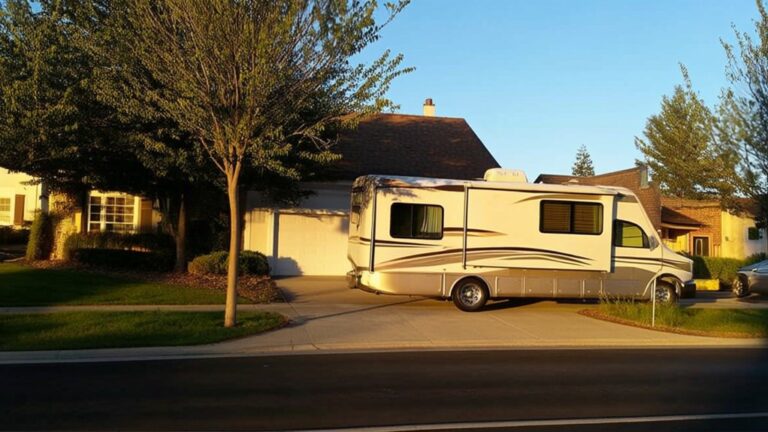
You can park an RV on the street, but you’ll face strict time limits. Typically, these last anywhere from 24 to 72 hours. Often, you’ll need a permit if you want to stay longer.
Rules vary widely depending on the city. They usually include size restrictions, especially for larger or commercial RVs. Make sure to check what applies in your area.
Enforcement can involve fines, citations, or even towing if you break the rules. This is especially true if you park overnight during prohibited hours.
So, it’s really important to check local laws and get any necessary permits. That way, you can avoid penalties and enjoy your stay without hassle. Explore more to understand specific regulations and practical tips for complying.
Understanding Time Limits and General Rules for RV Street Parking
Although regulations vary by location, you’ll typically find that cities limit RV street parking to between 24 and 72 hours before requiring you to move or remove your vehicle. Enforcement relies on methods like tire markings or surveillance to track how long your RV remains stationary.
Most cities restrict RV street parking to 24–72 hours, using tire markings or surveillance for enforcement.
Some jurisdictions issue special permits allowing longer stays, but these still mandate periodic relocation.
To comply, you must carefully review local ordinances and posted signage, as rules differ considerably across neighborhoods and municipalities. Ignoring time limits risks citations, fines, or even towing, which can be costly and inconvenient.
Staying informed about these regulations is essential to avoid penalties and ensure your RV parking remains lawful and hassle-free.
Always verify specific local restrictions before parking on residential streets. It’s better to double-check than to deal with unexpected trouble later. Taking a few minutes to look up the rules can save you a lot of headaches down the road.
How Long Can You Park an RV on the Street Without a Permit?
Knowing the general rules about RV street parking helps, but you also need to understand specific limits for parking without a permit. Most cities restrict RV street parking to between 24 and 72 hours without special authorization.
Exceeding these limits can lead to penalties such as fines, tickets, or towing.
Enforcement typically involves tire markings, visual checks, or surveillance to ensure compliance. Keep in mind that local laws and posted signs dictate exact time limits, which vary considerably by location. So, it’s important to check the rules where you’re parking.
Repeatedly overstaying without a permit increases the risk of enforcement actions. And even with permits, some areas require moving your RV periodically to avoid penalties.
It’s always a good idea to stay informed and follow local guidelines to keep your RV safe.
How to Get a Temporary Overnight RV Parking Permit
If you need to park your RV overnight on the street, securing a temporary overnight parking permit is often required by many cities. Start by proving residency with documents like a driver’s license, utility bill, or property deed that match your qualifying address.
Next, register for an online account where you’ll submit these documents and apply for the permit. The permit typically costs about $1.50 per 24-hour period and allows parking on your residential block for up to three consecutive days.
Be mindful of restrictions. Parking between 2 a.m. and 6 a.m. is usually prohibited, and your RV must remain at least 50 feet from intersections.
After approval, purchase the permit and display it as required to comply with local regulations and avoid fines. It’s a straightforward process once you have everything ready!
Navigating RV Street Parking Laws in Key Cities
When parking an RV on city streets, you have to navigate a patchwork of local laws that vary quite a bit across key urban areas. Understanding these regulations helps you avoid fines and towing.
Navigating diverse city RV parking laws is essential to avoid fines and towing hassles.
For example, San Diego grants a $1/day temporary permit for up to 72 nights annually per household, which makes short-term parking easier.
Los Angeles County has restrictions on RVs that are wider than 8 feet or longer than 20 feet, especially in residential zones.
Meanwhile, San Jose basically bans overnight street parking of RVs without special permits, focusing on residential neighborhoods.
These differences show why it’s so important to research city-specific rules before you park.
In Texas and Colorado, time limits and permit requirements also vary, so checking local ordinances is key to staying compliant and avoiding penalties.
RV Street Parking Restrictions for Large and Nonconforming Vehicles
Local ordinances often impose stricter street parking rules for large or nonconforming RVs because they can obstruct traffic, reduce visibility, and disrupt neighborhood aesthetics.
If your RV is wider than 8 feet, taller than 7.5 feet, or longer than 20 feet, it’s usually classified as nonconforming and faces tighter restrictions.
Many places don’t allow parking these vehicles overnight or for long periods on residential streets. This helps keep neighborhoods safe and prevents congestion.
Some areas also restrict street parking for RVs used commercially or those that don’t meet size standards.
Enforcement agencies keep a close eye on compliance. They can issue citations or even impound RVs that violate local rules.
Where Else Can You Legally Park Your RV Besides the Street?
Where can you legally park your RV besides the street? Several regulated alternatives exist, each with specific permissions and requirements.
First, private properties like driveways or backyards allow RV parking if you have the owner’s consent and local ordinances permit it.
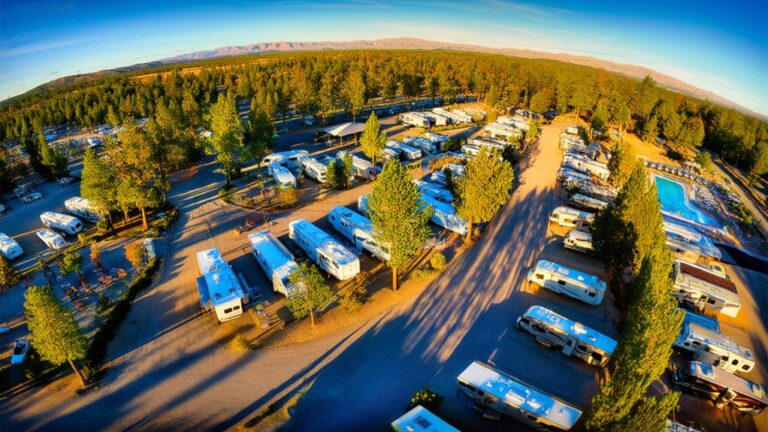
Second, designated campgrounds, RV parks, or resorts provide long-term parking options ideal for extended stays.
Third, public lands managed by agencies such as the BLM or US Forest Service permit boondocking in designated zones, but you must adhere to strict rules.
Additional options include casinos or commercial properties that may offer overnight parking with prior approval.
Always verify local regulations and obtain necessary permissions to guarantee compliance and avoid penalties.
- Private property parking with owner permission
- Designated campgrounds and RV parks
- Public lands for regulated boondocking
What Happens If You Park Your RV Illegally?
If you park your RV illegally, you could get hit with citations, fines, or even have your vehicle towed by law enforcement. It’s not just a one-time hassle either—if you keep violating parking rules, things can get worse. You might lose parking privileges or see your insurance rates go up.
Plus, parking illegally isn’t just about the penalties. It can also cause safety issues, like blocking traffic or making it hard for others to see when driving around your neighborhood.
Potential Legal Penalties
Although parking an RV illegally might seem like a minor infraction, you can face significant penalties including citations, fines, and even vehicle impoundment depending on the jurisdiction. These consequences vary by location but often escalate with repeated violations.
Ignoring local codes can lead to legal action or court-imposed fines, which might affect your ability to obtain or maintain parking permits.
Key potential penalties include:
- Issuance of citations and monetary fines based on local enforcement policies
- Increased restrictions or revocation of parking permits after repeated offenses
- Classification of violations as code infractions, risking legal proceedings and additional penalties
Understanding these repercussions helps you comply with regulations and avoid costly legal trouble when parking your RV on public streets. It’s always better to know the rules upfront than face unexpected consequences later.
Vehicle Towing Risks
When you park your RV illegally on the street, you risk law enforcement towing your vehicle without prior notice. This can result in hefty impound fees and storage charges. Authorities enforce local parking regulations strictly.
Towing may happen immediately if your RV obstructs traffic or violates size restrictions. Besides financial loss, towing can damage your vehicle or nearby property, which makes recovery more complicated.
If you keep violating the rules, consequences get worse. You could face higher fines, suspension of your vehicle registration, or even legal action. In some places, illegal RV parking can lead to criminal charges because of safety hazards.
Impact On Neighborhood
Since illegal RV parking can block sightlines at intersections, it really raises the risk of accidents in neighborhoods. When you park your RV where you shouldn’t, you’re not just risking safety—you’re also opening yourself up to fines or other penalties.
Neighbors often report these issues, which can lead to law enforcement or code enforcement stepping in. That might mean getting citations, fines, or even having your RV towed.
You should also think about how this affects the whole community. Visual clutter from unauthorized RVs can lower property values and make the neighborhood less attractive.
Plus, ongoing illegal parking can cause friction and disputes between neighbors. And to keep things under control, authorities might have to impose penalties or even impound vehicles.
Practical Tips for Finding and Securing Legal RV Parking
First, make sure to double-check your local parking laws and take a good look at all the street signs to see if RV parking is allowed and how long you can stay.
If you’re thinking about parking for a longer time, it’s a smart idea to look into any permits you might need so you stay within the rules.
Staying legal is key—not only to avoid fines but also to keep your RV safely parked without any trouble.
Verify Local Parking Laws
Although regulations vary widely between municipalities, you should always verify local parking laws before leaving your RV on the street overnight. Start by consulting city or county websites for precise rules on RV street parking, as these sources provide official guidelines.
Next, carefully examine any posted signage at your intended parking spot to identify restrictions, time limits, or permit requirements.
Finally, reach out to local transportation or parking authorities to confirm your findings and clarify any uncertainties.
To make this process easier, consider these simple steps:
- Check municipal websites for RV-specific parking rules.
- Observe posted signs for time limits or permit mandates.
- Contact local authorities to verify legality and permit needs.
Explore Permit Options
When you need to park an RV on the street legally, securing the appropriate permit is often essential. Many cities, like San Diego, offer temporary or long-term permits costing about $1.50 per day. These permits usually allow parking at the same address for up to three consecutive days, with a yearly cap of 72 permits per household.
To qualify, you must provide proof of residency or ownership, such as a driver’s license or utility bill. Keep in mind, parking between 2 a.m. and 6 a.m. is often prohibited, even with a permit. So, it’s always a good idea to verify local rules before applying.
| Permit Type | Duration Allowed | Requirements |
|---|---|---|
| Temporary | Up to 3 consecutive days | Proof of residency/ownership |
| Long-term | Multiple permits yearly | Identification documents |
| Restricted Hours | 2 a.m. – 6 a.m. ban | Compliance with local laws |
Frequently Asked Questions
Can I Connect My RV to Street Utilities While Parked?
You can’t connect your RV to street utilities without permits and local approval. Most cities prohibit direct hookups to water, sewer, or electricity to avoid fines.
Always check regulations and secure proper authorization first. It’s better to be safe than sorry when it comes to legal stuff!
Are There Noise Restrictions for RV Street Parking?
Noise restrictions for RV street parking are strict and precise. You must keep noise below local decibel limits. Avoid loud generators or music, especially between 10 p.m. and 7 a.m.
If you don’t, you could face fines. So, it’s best to be mindful of the noise you make while parked on the street.
Is Street Parking Allowed for RVS During Street Cleaning Days?
You can’t park an RV on the street during street cleaning days in most cities. Ignoring posted restrictions risks fines or towing. Always check local schedules and signage to avoid penalties and guarantee compliance with regulations.
It’s really important to stay informed about when street cleaning happens. That way, you won’t accidentally get stuck with a ticket or worse. Just a quick look at the signs or city website can save you a lot of hassle.
Can I Run a Generator While Parked on the Street?
You generally can’t run a generator while parked on the street due to noise and air quality regulations.
It’s a good idea to check local ordinances carefully. Many areas prohibit running generators without permits or during certain hours to avoid disturbing neighbors.
Are There Insurance Requirements for Street-Parked RVS?
Yes, you need at least liability insurance for street-parked RVs. The specific coverage requirements vary depending on your location.
For example, California requires all-encompassing policies if you’re a full-time RV resident. If you don’t insure properly, you could face fines, penalties, or even lose your registration.
Conclusion
So, you want to park your RV on the street? Sure, just make sure you’ve memorized every city’s time limits, permit rules, and size restrictions. Nothing says “adventure” like a bureaucratic scavenger hunt.
Ignore them, and you might wake up to a ticket or tow. Your RV’s new home could be a municipal impound lot.
Play it smart: research, get permits, and park legally. Or get ready to star in your own towing drama.