How Much Does It Cost to Build and Start an RV Park – Facts & Detailed Figures
You’ll need between $100,000 and over $1 million to build and start an RV park, depending on land size, site prep, permits, and utility hookups. Infrastructure and amenities like pools or paved roads can add $50,000 to $200,000 each.
Financing often covers 85% of costs with loans around $900K, while annual operating expenses average $2.9 million. Managing occupancy and pricing boosts revenue and profits.
Explore how layout, amenities, and cost control shape success. It’s all about balancing what you spend with what you offer to your guests.
Land Purchase and Site Preparation Costs

When planning to build an RV park, you’ll need to budget carefully for land purchase and site preparation. Land costs vary widely, typically from $5,000 to $50,000 per acre, depending on location and nearby attractions.
Careful budgeting for land purchase and site preparation is crucial when planning an RV park.
For a standard 3-acre park, expect to pay between $15,000 and $150,000.
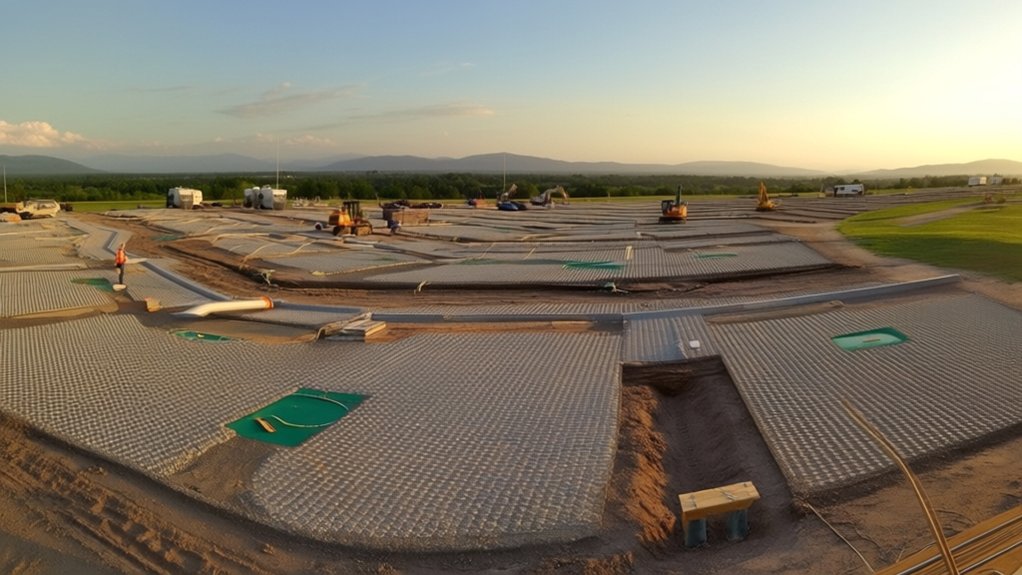
Site preparation adds significant expense. Grading, excavation, clearing debris, and dirt work can range from $10,000 to $50,000 or more.
Per acre, clearing and preparation often cost between $5,000 and $25,000.
Don’t underestimate the impact of additional tasks like site leveling, drainage installation, and retention pond construction. These are essential for infrastructure stability and can substantially increase your upfront investment.
Your budgeting must reflect these variable yet critical components for a successful build.
Budgeting for Permits, Zoning & Utility Hookups

Although securing permits and zoning approvals can be complex, you’ll need to allocate between a few thousand dollars and over $20,000 depending on your project’s location and scale. This cost includes zoning approvals, building permits, and environmental clearances.
Utility hookups, covering water, sewer, and electrical connections, typically range from $5,000 to $25,000 per site. Site preparation, such as trenching and meter installation, often accounts for 30-50% of these costs.
For example, in Texas, compliance with TCEQ regulations and obtaining water and sewer permits can add several thousand dollars to your budget. Planning these expenses early in the permitting process helps you avoid unexpected financial setbacks and construction delays.
It ensures a smoother, more predictable development timeline.
RV Park Construction and Infrastructure Cost Drivers
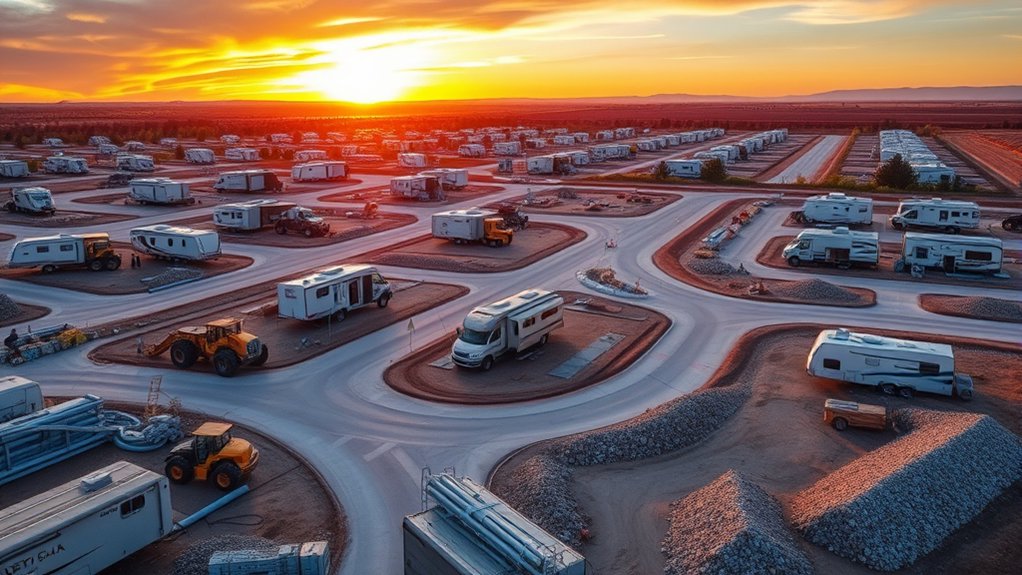
You’ll find that site preparation alone can add thousands per spot, especially when grading and retention features come into play.
And when it comes to utility infrastructure—think water, sewer, and electrical hookups—that often pushes costs even higher, especially for upscale parks.
On top of that, developing amenities like paved roads and recreation areas will also increase your overall investment.
Site Preparation Costs
Because site preparation forms the foundation of your RV park, understanding its costs is essential for accurate budgeting. Site prep expenses typically range from $10,000 to $50,000 per acre, influenced by soil type, grading, and drainage needs. Complex terrain or wetlands can push costs higher due to specialized excavation.
Paved roads, concrete pads, and retention areas often add more than $20,000 per acre in advanced projects. You’ll need detailed site assessments to pinpoint exact requirements and avoid surprises.
| Cost Driver | Typical Range Per Acre |
|---|---|
| Dirt Work & Grading | $10,000 – $30,000 |
| Drainage Systems | $5,000 – $15,000 |
| Paved Roads & Pads | $15,000 – $25,000+ |
Precise estimates depend on your site’s unique conditions.
Utility Infrastructure Expenses
Following site preparation, allocating funds for utility infrastructure becomes a vital component of your RV park budget. Expect to spend between $10,000 and $25,000 per site, largely influenced by the level of utility hookups you provide. Sewer, water, and electrical systems, especially 50A electrical hookups, can sharply increase costs.
Trenching, grading, and connecting to public utilities add thousands more, so plan carefully. Choosing between public utility connections and private wells or septic systems impacts your initial capital investment greatly.
Additionally, paved roads, lighting, and individual utility meters increase expenses but are essential for accommodating large RVs and ensuring guest satisfaction.
Your decisions on these infrastructure elements directly determine both upfront costs and long-term operational efficiency. So, it’s worth weighing all your options carefully to get the best balance between cost and quality.
Amenity Development Impact
While planning your RV park’s infrastructure, consider that amenity development can substantially influence your overall construction costs. Facilities like pools, playgrounds, and clubhouses can add $50,000 to $200,000 each, depending on size and quality.
High-end utility setups, such as 50A electrical service, sewer, and water hookups, range from $10,000 to $25,000 per site, varying by site conditions.
Paved roads and concrete pads contribute $5,000 to $15,000 per site, based on materials and length.
Landscaping, lighting, and recreational features such as fire pits can add another $10,000 to $50,000, enhancing guest appeal.
Don’t overlook site preparation costs like grading, drainage, and retaining walls, which run $5,000 to $20,000 per acre and directly affect whether you can install amenities easily.
Accurately budgeting these elements is essential for controlling your project’s financial scope.
How RV Park Amenities and Layout Impact Build Costs
When you plan your RV park’s amenities and layout, you directly impact your build costs and guest satisfaction. Essential hookups like water, electric, and sewer typically cost $5,000 to $15,000 per site. These hookups form a significant portion of your budget.
Adding luxury features such as pools or clubhouses can increase total development costs by 20 to 50%. Layout decisions also influence expenses. For example, wider roads and larger buffers raise construction costs but really enhance the guest experience.
Site density matters too. Optimizing for 10 to 20 sites per acre affects how many units you can build and your overall scale.
Finally, driveway surfaces vary in cost. Gravel is the cheapest option, while concrete is the most expensive but also the most durable.
Balancing these factors lets you control costs while delivering a quality park layout and amenities. It’s all about finding the right mix for your budget and your guests.
Financing Options for Building Your RV Park
Although securing financing for your RV park can be complex, understanding your options is essential to moving forward. SBA loans are the most common choice, typically covering about 85% of project costs with average loan amounts near $932,000. You’ll likely need a 10% down payment, roughly $95,000 upfront.
To qualify, prepare a detailed business plan with financial projections focusing on occupancy rates, revenue streams, and cost estimates.
SBA loan interest rates range from 4% to 8%, with repayment terms between 10 and 25 years.
Alternatively, you can explore traditional bank loans, private investors, crowdfunding, or partnerships, especially if your project offers unique amenities or location advantages.
An analytical approach to financing will optimize your capital structure and project viability.
RV Park Ongoing Operating Costs to Expect
Because operating costs directly impact your RV park’s profitability, understanding their breakdown is essential. Median annual expenses hover around $2.89 million, with general costs near $1.85 million. Utilities alone take up 15–20% of total expenses, while maintenance, staffing, marketing, and property taxes form significant ongoing costs.
Capital expenses for upgrades are notable but smaller annually. Costs vary by park size, location, amenities, and occupancy. It really depends on the specifics of your park.
| Expense Category | Percentage of Total Cost | Estimated Annual Cost (Million $) |
|---|---|---|
| Utilities | 15–20% | 0.43 – 0.58 |
| Maintenance & Repairs | 20–25% | 0.58 – 0.72 |
| Staffing | 20–30% | 0.58 – 0.87 |
| Marketing | 5–10% | 0.14 – 0.29 |
| Property Taxes | 10–15% | 0.29 – 0.43 |
Estimating RV Park Revenue and Profitability
You can expect nightly site rentals to bring in the biggest chunk of your revenue. On average, they generate about $1.43 million annually out of a total $3.52 million.
Occupancy rates play a huge role here—especially the 68% average for full hook-up sites—which means keeping those sites booked is key to maximizing your earnings.
Of course, it’s important to balance these income streams against your operating expenses, which typically run around $2.89 million each year.
Keeping an eye on both revenue and costs is essential if you want to stay profitable.
Revenue Streams Breakdown
When estimating RV park revenue and profitability, understanding the breakdown of income streams is essential. Nightly, weekly, monthly, and seasonal site rentals form the core revenue. Nightly rates typically range between $40 and $80.
Site rentals contribute roughly $1.43 million annually to a median total revenue of $3.52 million.
Ancillary services such as propane sales, Wi-Fi access, and long-term storage contracts help diversify income and boost profitability.
However, operating expenses consume about 80-85% of gross revenue. These include utilities, maintenance, and staffing costs. These costs directly impact your net profitability.
Occupancy Impact Analysis
Understanding the breakdown of revenue streams sets the stage for analyzing how occupancy rates directly affect your RV park’s financial performance. Full hook-up sites averaging 68% occupancy during peak months drive the bulk of your revenue, while rustic sites at 25% occupancy contribute less.
Seasonal fluctuations demand strategic rate adjustments, typically a 5% increase in peak season, to maximize profitability. Tracking these patterns helps you optimize site use and pricing.
| Site Type | Avg. Occupancy | Seasonal Rate Adjustment |
|---|---|---|
| Full Hook-up | 68% | +5% |
| Rustic/Tent | 25% | Minimal |
| Overall Average | ~46.5% | Variable |
Higher occupancy combined with smart pricing substantially boosts gross revenue and ROI. It’s all about finding the right balance to make the most of your park’s potential.
Operating Cost Factors
Although gross revenue sets the foundation for your RV park’s financial health, operating costs directly shape profitability and cash flow. Typically, these expenses consume 40% to 50% of your gross revenue, covering utilities, maintenance, staffing, and taxes.
Utilities alone, like electricity, water, and sewer, account for 15% to 20% of total operating costs, but this can vary depending on usage and rates.
Occupancy rates play a critical role in your bottom line. For example, full hook-up sites average about 68% occupancy during peak months.
To stabilize cash flow and improve margins, it’s a good idea to diversify revenue streams beyond just site rentals. Adding amenities and ancillary services can make a big difference.
Consistently analyzing expenses and occupancy trends helps you fine-tune pricing and control costs, which maximizes profitability.
Managing these factors precisely is key to ensuring your RV park operates with sustainable financial performance.
Frequently Asked Questions
What Is the Best Season to Start Building an RV Park?
You should start building an RV park in spring or early summer. These seasons offer favorable weather and lower contractor demand.
That way, you can finish the project on time before the peak camping season hits. This helps maximize occupancy and minimize weather-related construction delays.
Starting at the right time really makes a difference!
How Do Weather Conditions Affect RV Park Construction Timelines?
Weather delays your RV park construction by causing site access issues, slowing concrete curing, and restricting work seasons. You’ll face higher costs and longer timelines due to necessary safety measures, extra labor, and specialized drainage solutions.
It’s not just about waiting out the rain or snow. These conditions can really throw off your schedule and budget. So, planning ahead with weather in mind can save you a lot of headaches down the line.
What Insurance Policies Are Essential for New RV Park Owners?
You’ll need general liability, property, workers’ compensation, and commercial auto insurance. These cover legal claims, property damage, employee injuries, and vehicle-related risks.
Having these policies in place helps keep your RV park’s operations protected and compliant with regulations. It’s all about making sure you’re covered from different angles so you can focus on running your business smoothly.
How Can Technology Improve Guest Experience at an RV Park?
Technology transforms travel with timely tools, trimming wait times through contactless check-ins and online bookings. You’ll boost guest satisfaction by providing seamless Wi-Fi, smart utility tracking, and real-time feedback.
These features enhance efficiency and engagement with measurable results. It’s all about making the stay smoother and more enjoyable for everyone. Technology really changes the game at RV parks.
What Are Common Mistakes First-Time RV Park Builders Make?
You often underestimate site analysis, overlook utility capacity and zoning, and neglect detailed hookup planning. Missing the importance of signage and accessibility can also cause problems.
Plus, skipping thorough local regulation checks can lead to costly delays. These mistakes add up to infrastructure issues and reduced profitability in your first RV park project.
Taking the time to plan carefully really pays off in the long run.
Conclusion
Building and starting your RV park requires thoughtful investment, not just in dollars but also in strategic planning. Upfront costs like land, permits, and infrastructure can seem substantial. But they lay the groundwork for smooth operation.
By carefully balancing amenities and financing, you create a welcoming destination that attracts steady revenue. With clear budgeting and ongoing cost management, your RV park can transform from a hopeful vision into a profitable reality. It will steadily cruise toward success.